Robotics | Exploration
Into the Blind Spot – The Patient Explorer
There are places in the Amazon where no human has set foot in generations, perhaps ever. Vast stretches of forest canopy shield ecosystems we’ve barely begun to catalog, let alone understand. The deeper you venture, the more inaccessible it becomes. Rivers flood without warning. Heat and humidity corrode equipment within days. Dense vegetation forms barriers that turn a hundred-meter journey into an hours-long ordeal. These brutal conditions do more than challenge expeditions. They create a vast blind spot in our scientific understanding, leaving entire ecosystems unstudied simply because we cannot stay long enough to observe them.
Somewhere in that green labyrinth, species exist that could revolutionize medicine. Soil microbes are processing carbon in ways we don’t yet comprehend. Symbiotic relationships between plants, insects, and fungi are solving problems that our best engineers are still trying to crack. But accessing these answers requires a presence we cannot sustain. Human expeditions are brief, expensive, and constrained by bodies that cannot endure what the rainforest demands. We visit. We sample. We leave before the environment claims our equipment and exhausts our reserves. The deep interior remains largely untouched, its mysteries intact.
This is where Promise will make its home.
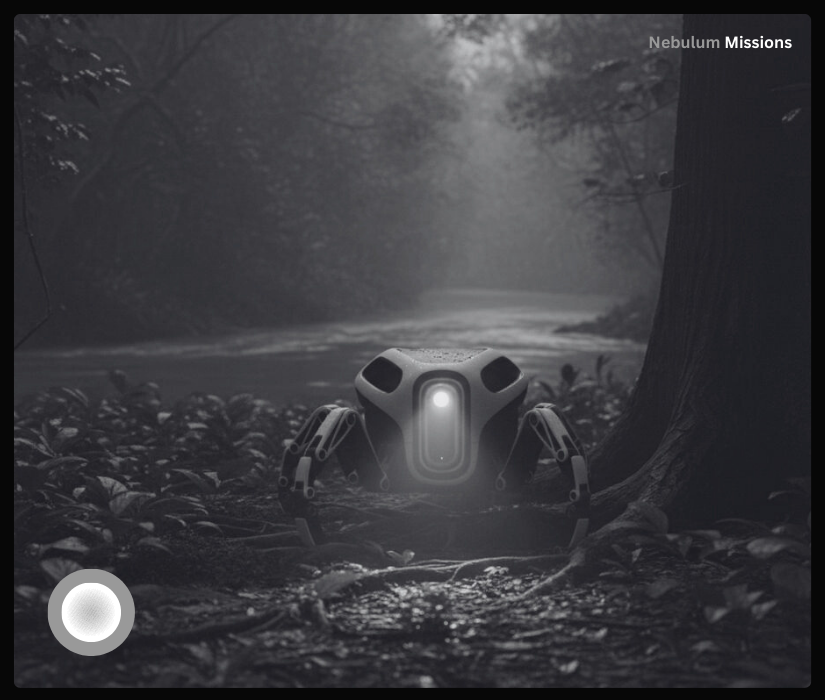
Promise: Artist Concept
Learning to Belong
Traditional field research asks humans to venture into hostile environments with heavy equipment, limited time, and bodies that tire, overheat, and need constant resupply. We keep trying to impose our rhythms on places that operate on entirely different timescales. What if we could create something that belongs there instead?
Intelligence That Adapts
Promise represents a shift in how we think about exploration itself. This rover arrives in the rainforest as a student. Its self-learning navigation system means it will fail, adjust, and try again, gradually building an understanding of terrain that no human programmer could anticipate from a lab thousands of miles away. When Promise encounters a river too deep to cross, it learns. When vegetation blocks a path, it adapts. The intelligence emerges from the environment itself.
Science Without Silos
The modular payload system reflects a deeper philosophical commitment. Science doesn’t happen in silos, yet our tools often force us to choose: do we study soil composition or canopy biodiversity? Hydrology or insect populations? Promise says we can do both, and more. By creating a platform that accepts diverse scientific instruments, we’re acknowledging that understanding complex ecosystems requires asking multiple questions simultaneously.
Working Within Limits
Solar power keeps Promise alive, but it also keeps it honest. There’s no emergency extraction, no quick resupply mission if something goes wrong. The robot must work within the energy budget the sun provides, just like every other organism in that ecosystem. This constraint isn’t a limitation. Constraints breed creativity, resilience, and genuine adaptation.
A Commitment to the Future
We chose the name Promise deliberately. Every exploration mission carries within it an implicit promise to the future: that we will learn something worth knowing, that we will expand the boundaries of human understanding, that we will treat the places we study with the respect they deserve. Promise the rover embodies that commitment. It’s designed to coexist with the Amazon, gathering knowledge while leaving minimal traces of its presence.
The Undiscovered Majority
Consider what waits in that darkness. We’ve identified perhaps 10% of Earth’s fungal species. The other 90% continue their work unseen, many in Amazonian soil, producing compounds that could redefine medicine just as penicillin once did. Scientists estimate 80 to 90% of insect species remain undescribed, many harboring biomimetic solutions to engineering problems we’re still trying to solve. Less than 1% of soil bacteria have been sequenced, and among them may be organisms capable of breaking down the plastics choking our oceans or sequestering the carbon warming our atmosphere. The canopy ecosystem, 100 to 200 feet above ground, remains one of Earth’s least-studied habitats. Its chemical exchanges and symbiotic networks have gone largely unmapped. Beneath the surface, mycorrhizal fungi connect trees across vast distances through communication systems we’re only beginning to understand. In 2026, Promise will begin transmitting its first observations from deep in the rainforest, introducing us to the organisms that have already solved the problems we’re still trying to define. The Amazon holds answers that could transform medicine, agriculture, and our understanding of planetary systems. We’re finally building something patient enough to find them.
LET'S TALK
Discuss Your
Hardware & Software
Needs With Us
OUR NEWSLETTER
MACHINES
Embedded Systems
Machine Intelligence
Machine Learning
Sensor Systems
Computer Vision
@NEBULUM 2026. ALL RIGHTS RESERVED