Space | Planetarium
Creating Sanctuaries for Wonder
There’s a particular feeling you get when you first see Saturn’s rings cast shadows on Europa’s icy surface, or watch 70,000 asteroids trace their ancient orbits through the solar system. You get a sudden awareness of scale, of time, of the unfathomable complexity humming along just beyond our atmosphere. It’s wonder, and we think the world needs more of it.
That’s why we launched the Interactive Cosmos Explorer, Nebulum’s new web-based planetarium.
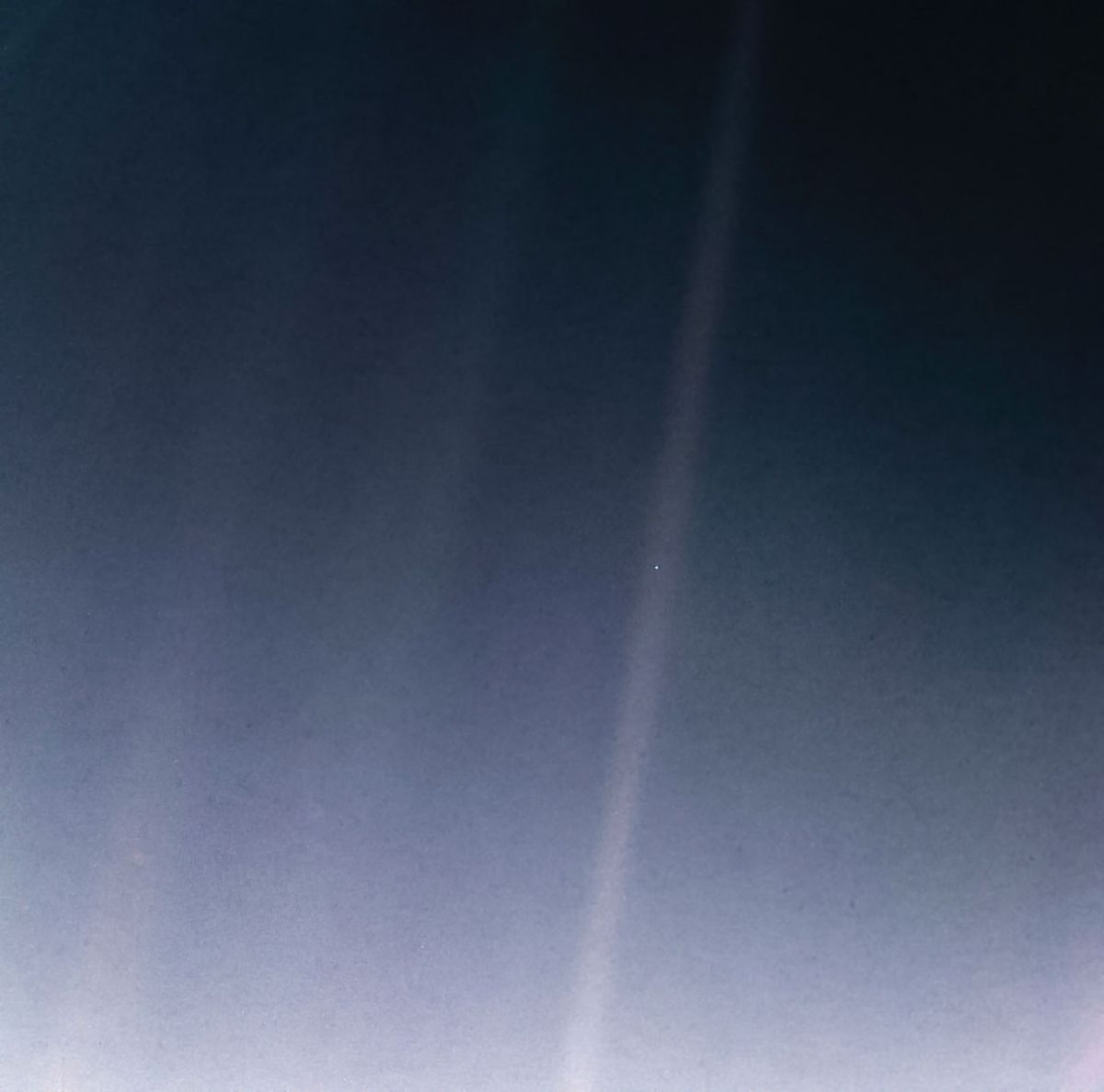
NASA/JPL-Caltech
The Pale Blue Dot
In 1990, Voyager 1 turned its camera back toward Earth from 3.7 billion miles away and captured a single pixel of light: our entire world reduced to a pale blue dot suspended in a sunbeam. That photograph, and Carl Sagan’s reflection on it, inspired us to launch this planetarium. Sometimes perspective is the most powerful gift we can offer.
“Look again at that dot. That’s here. That’s home. That’s us. On it everyone you love, everyone you know, everyone you ever heard of, every human being who ever was, lived out their lives. The aggregate of our joy and suffering, thousands of confident religions, ideologies, and economic doctrines, every hunter and forager, every hero and coward, every creator and destroyer of civilization, every king and peasant, every young couple in love, every mother and father, hopeful child, inventor and explorer, every teacher of morals, every corrupt politician, every “superstar,” every “supreme leader,” every saint and sinner in the history of our species lived there-on a mote of dust suspended in a sunbeam.
The Earth is a very small stage in a vast cosmic arena. Think of the endless cruelties visited by the inhabitants of one corner of this pixel on the scarcely distinguishable inhabitants of some other corner, how frequent their misunderstandings, how eager they are to kill one another, how fervent their hatreds. Think of the rivers of blood spilled by all those generals and emperors so that, in glory and triumph, they could become the momentary masters of a fraction of a dot.
Our posturings, our imagined self-importance, the delusion that we have some privileged position in the Universe, are challenged by this point of pale light. Our planet is a lonely speck in the great enveloping cosmic dark. In our obscurity, in all this vastness, there is no hint that help will come from elsewhere to save us from ourselves.
The Earth is the only world known so far to harbor life. There is nowhere else, at least in the near future, to which our species could migrate. Visit, yes. Settle, not yet. Like it or not, for the moment the Earth is where we make our stand.
It has been said that astronomy is a humbling and character-building experience. There is perhaps no better demonstration of the folly of human conceits than this distant image of our tiny world. To me, it underscores our responsibility to deal more kindly with one another, and to preserve and cherish the pale blue dot, the only home we’ve ever known.”
― Carl Sagan, Pale Blue Dot: A Vision of the Human Future in Space
Building in Sagan’s Spirt
Sagan believed that science extended far beyond equations and discoveries. For him, it was a path toward cultivating humility, perspective, and a deeper sense of our place in the cosmos. He spent his life making the universe accessible, convinced that understanding our cosmic context could fundamentally change how we see ourselves and each other.
That conviction drives everything we do at Nebulum. We’re builders, artists, tinkerers, and inventors. We’re futurists who tackle big problems by designing technology that enhances rather than diminishes human potential. Nebulum Labs codes for the long arc of human flourishing. We believe technology should expand curiosity and invite exploration.
Sometimes, that means launching something just because it should exist.
Why a Planetarium?
The universe operates on timescales that dwarf human ambition. It presents mysteries that demand patience, beauty that resists shortcuts, and complexities that humble even our most sophisticated instruments. When you navigate through our planetarium and watch Uranus’ moons orbit at their bizarre 98-degree tilt, or trace the path of the International Space Station, or explore the Trojan asteroids clustered at Jupiter’s Lagrange points, you’re engaging with real data about real celestial mechanics.
The planetarium runs on the same datasets that scientists use, built on open-source technology and made accessible through any web browser. We put it together using I, Voyager and Godot Engine, extending it to create an experience anyone can access freely.
Exactly as Sagan would have wanted it.
The Data Holds Secrets
When you combine our planetarium with our other projects (the Mars Rover Photo API and the James Webb Space Telescope API), you’re accessing the same datasets that researchers use to make discoveries.
Real discoveries happen in these datasets. Patterns emerge. Questions form. Someone exploring Mars rover imagery might notice a geological formation that sparks a new hypothesis. Someone examining JWST spectral data might spot an anomaly worth investigating. The planetarium adds spatial and temporal context to these observations. You can see where Mars was when Curiosity captured that image, or when JWST was observing that particular region of space.
The possibility of discovery matters. When you democratize access to scientific data, you create opportunities for unexpected insights. The next person to ask the right question could be anywhere, could be anyone.
So Much Left to Explore
Despite all we’ve learned about our solar system, we’ve barely scratched the surface. We’ve visited a tiny fraction of the asteroids orbiting out there. We don’t fully understand Saturn’s hexagonal storm or Europa’s subsurface ocean. We’re still discovering moons around distant planets. Mysteries abound, and we’re only beginning to ask the right questions.
This planetarium is our invitation to wonder. Exploration continues. Science remains unsettled. Entire worlds spin through space right now that we know almost nothing about. Each pixel in this simulation represents real space, real distances, real objects following laws we’re still learning to understand.
Gifts to Future Humanity
At Nebulum Labs, we think about the long arc. We’re building gifts to future humanity: tools and resources that might inspire someone who hasn’t discovered them yet. Maybe someone exploring this planetarium tonight will, in the future, design the spacecraft that finally visits those Trojan asteroids. Maybe another person will use our APIs to create something we can’t even imagine yet.
This is how curiosity compounds across generations. Sagan inspired countless scientists and explorers not through lectures about duty, but by sharing his genuine awe at the cosmos. He showed us that understanding our smallness elevates us rather than diminishing us. We become participants in something ancient and ongoing. Our brief moment of awareness joins a story billions of years in the making.
So go ahead. Navigate to Europa. Watch Jupiter rise over an alien horizon. Trace the orbit of Pluto on the day New Horizons flew past. Take your time. Ask questions. Feel small in the best possible way.
The cosmos is waiting, and everyone can explore it freely.
LET'S TALK
We’re building the future of
AI-powered earth observation
and geospatial intelligence.
OUR NEWSLETTER
USE CASES
Finance & Investing
Journalism & Research
Environmental
Agriculture & Forestry
Infrastructure
OSINT
CAPABILITIES
@NEBULUM 2026. ALL RIGHTS RESERVED