NEBULUM.ONE
The Art of Reaching for the Impossible
An ode to independent makers and dreamers who build beyond limits. What the Mars rovers teach us about creativity, courage, and the human will to reach.
 We build with heart
The Art of Reaching For The Impossible
To build is to reach across distance: between idea and matter, dream and reality.
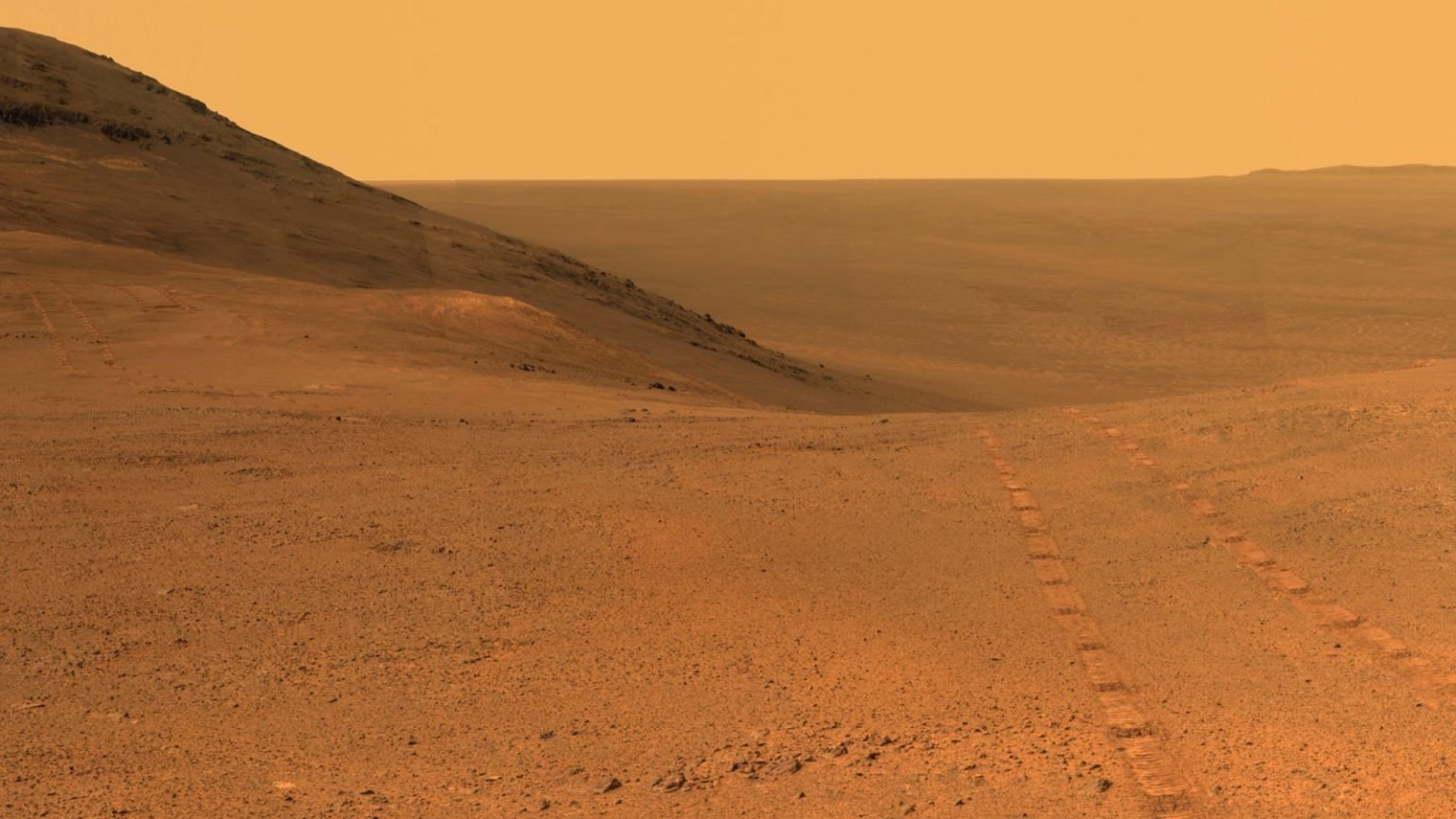
Image credit: NASA/JPL-Caltech/Cornell/Arizona State Univ.
I want to tell you something that matters deeply to me: machines extend what it means to be human. They carry us to places our bodies cannot go, reveal truths our senses cannot detect, and venture into conditions that would destroy us. They are our emissaries to the depths of the ocean and the surface of distant worlds, our partners in discovery, our way of reaching beyond our own biological limits.
For me, building machines has always been about giving humanity reach.
From telescopes and sensors to rovers and embedded systems, humans have always built tools that let us touch places we cannot physically go. Every instrument we create is an extension of our curiosity, our perception, and our desire to understand worlds beyond immediate reach.
The same impulse that sent a robotic rover across nearly 140 million miles of space is the impulse behind every meaningful hardware system built today. It is the instinct to capture signals from the physical world, translate them into knowledge, and make them available to others.
At Nebulum Labs, this idea guided our work on the Mars Rover Photo API. This API acts as a bridge between a physical machine on another planet and the people here on Earth who want to learn from it.
The rover’s cameras, sensors, radios, and compute systems form a chain that begins on Martian soil and ends on a screen in someone’s hands. Our work simply made that chain easier to access. We took raw scientific output from a real machine operating in a hostile environment and turned it into something people could explore, study, and build upon.
This essay is about why that matters. It is about machines as extensions of human intention, about hardware as a form of inquiry, and about the deep satisfaction of building systems that reach farther than we ever could alone.
The First Light
The first time I saw the faint twin tracks pressed into Martian dust, I felt something within me shift: a quiet awe that humanity had left its signature on another world. A Martian world. A world no human has ever stepped foot on. And yet, on this planet, nearly 140 million miles away, there have tread mechanical feet. Six rovers and a small helicopter.
These robotic explorers became my mechanical heroes. I admire them as I admire explorers like Ernest Shackleton and Percy Fawcett, not just for where they went, but for what they revealed about our unrelenting will to go further and to learn more.
The image above shows tracks of Opportunity, a robotic explorer, imprinted in Martian terrain. These tracks are a symbol of human genius, imagination, creativity, hope and perhaps most importantly… human reaching.
Looking at this photo always rearranges something in me. The dusty orange horizon, the texture of the sand, the vastness, loneliness and beauty of an empty planet. A planet which someday we might call home.
For me, this image is a portrait of human creativity itself. The sheer chain of tinkering, failure, and trial and error that brought this image to my screen is almost beyond comprehension. Photons that traveled millions of miles, reflected off a world no human has ever touched, were caught by sensors, translated into data, compressed, transmitted through the cold silence of space, and finally unfolded as light on my laptop, in the warmth of my living room here on planet earth.
Behind that simple miracle is a lineage of minds: from Galileo’s first telescope to Maxwell’s equations of light, from Babbage’s mechanical computations to Turing’s logic of machines. Each inventor, each small leap of curiosity, stacked upon another until the impossible became possible. A photograph from Mars.
When I stare at these photos (I mean really stare), distance collapses. A machine we made had looked outward and sent back proof of its own existence on another planet. In these moments, I feel both infinitely small and quietly infinite.
There is, of course, beauty in these images; the soft light, the rusted sands, the vastness, but the deeper beauty, for me, lies in the gesture itself: human reaching.
In this article, I want to use the story of the Mars rovers to remind you (and myself) to keep reaching in what we build.
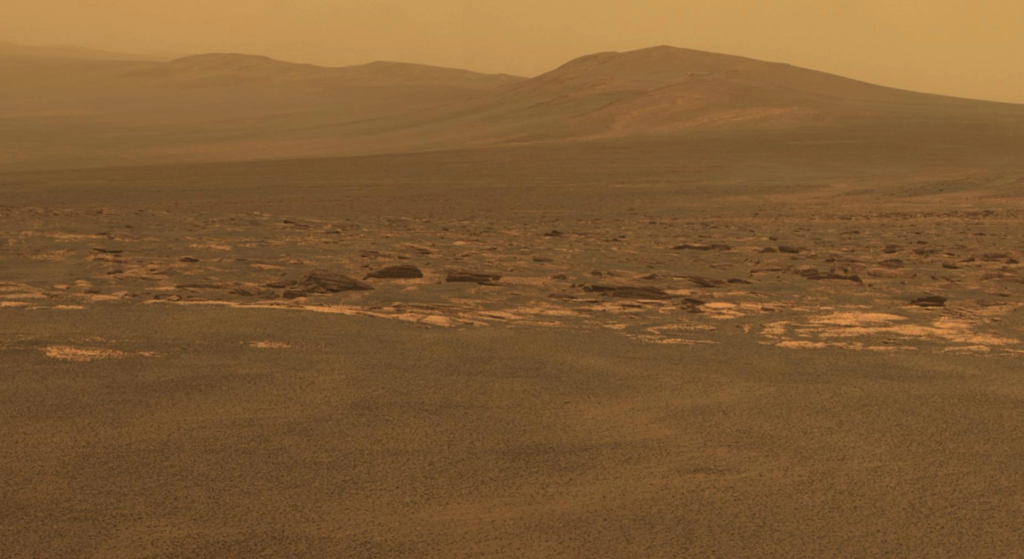
Image credit: NASA/JPL-Caltech/Cornell/Arizona State Univ.
Building Technology Worth Caring About
When Opportunity, the rover that had wandered the Martian plains for fifteen years, sent its final data transmission, NASA received nothing poetic. Just packets of telemetry, signals dimming as sunlight fell away from its solar panels.
But then a reporter translated those last readings into human language:
“My battery is low, and it’s getting dark.”
The phrase broke the internet and, more curiously, broke our hearts. I remember feeling tears rise within me. How could a robot’s silence feel like grief? Was I being manipulated by clever phrasing, a marketing sleight of hand designed to tether my empathy to a government program?
Maybe. But I decided it didn’t matter. I’d cried over machines before, and no manipulation was required. Empathy for machines seemed programmed into me from an early age. The first time was as a child, watching our family car (a 1990s Plymouth Sundance) get towed to the junkyard. More recently, as an adult, I found myself whispering to and patting reassuringly a boat in rough weather, pleading with it to keep me and my family safe. Like so many humans, I’m no stranger to communicating with machines, praising them, scolding them, even petting them.
We are, it turns out, a species strangely fluent in attachment. It might seem irrational, but it carries a certain beauty. We give ships and rovers names and pronouns (biologically incorrect, of course, but it’s how we connect to our mechanical world). The first boat builders did it not out of confusion, but because even then, we understood: what carries you deserves a name. And maybe, just maybe, the care and respect we give might one day be returned.
I think we cry and we care because technologies like the Mars rovers, like Shackleton’s James Caird, like my dad’s Sundance, expand our humanity rather than diminish it.
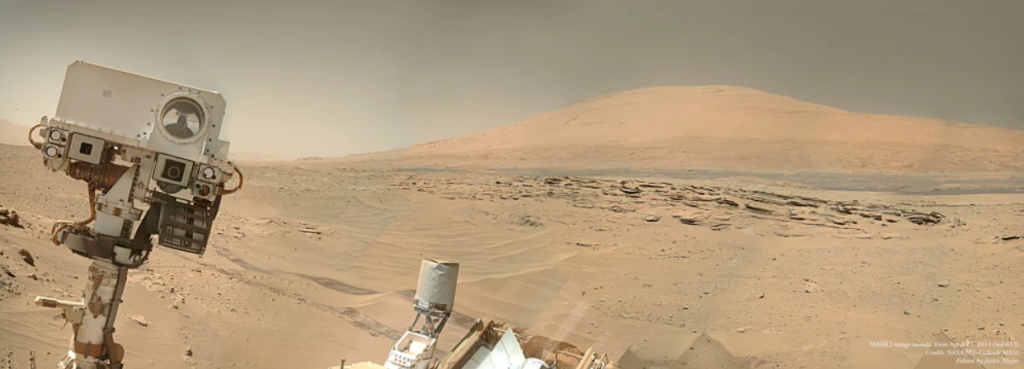
The (5.5-kilometer-high) Mount Sharp can be seen behind Curiosity rover.
Why Progress Matters
But it’s not enough to build things we care about, or even things others care about. We need to understand why we reach in the first place. Without that, what separates creation from mere production?
Why spend decades and billions to send a machine into space?
Because reaching is important.
Because reaching is the signature of consciousness.
To reach is to defy entropy, not only in the mechanical world, but in the world of art, thought, and feeling. Every act of creation, whether it’s a machine rolling across Martian soil, a new dance or a brushstroke on a blank canvas, is a small rebellion against the drift toward sameness. Entropy wants repetition, silence, decay. But reaching (that human impulse to imagine something different) introduces form, color, meaning, order.
The engineer who builds, the artist who paints, the writer who shapes language into rhythm: all are performing the same act of defiance. They are saying, something more is possible. Each new idea, each experiment, each attempt to stretch what is known pushes back the quiet slide into uniformity.
To reach, in any domain, is to participate in the oldest creative gesture: to turn the raw matter of existence into something that wasn’t there before.
Reaching rejects the forces that would keep us still.
Against nihilism, which holds that life has no inherent meaning and all striving is futile, reaching says: it does matter. Growth requires tension. Transformation requires movement. Reaching embraces disturbance as a creative force.
Against fatalism, which claims the future is already fixed and we are merely passengers, reaching insists we are pilots.
Against comfort, which says that stability and repetition are safer than exploration, reaching resists the quiet erosion of wonder. It rejects the seduction of what already works in favor of what might be possible.
To reach is to declare that what exists is not yet enough. It’s not for everybody, but I do believe it is a worthwhile and honorable endeavor for both the individual maker and the collective mind.
For the maker, reaching is a way of enlarging the self. Each act of construction is a small act of self-defiance, a challenge to yourself. We build mechanisms not only to solve problems but to feel the texture of possibility under our fingertips.
For the collective, reaching is how a civilization keeps from collapsing inward. It’s how curiosity survives comfort. Without that outward motion (toward Mars, toward understanding, toward each other), we risk becoming a closed loop of our own satisfaction.
The truth is that in billions of years, our planet will die. When the sun exhausts its fuel, Earth will be consumed by the very light that once nurtured it. Long before then, the oceans will boil and memory itself will evaporate. Mars, however, might be spared. It sits just far enough from the sun to escape the same fate.
So I see the small machines we send into the dark today as gestures of defiance and devotion. They are gifts to a future humanity we will never meet, proof that we tried to extend the human story beyond a single world. These Mars rovers are proof we’re trying to be good ancestors.
Each rover is a seed flung into cosmic soil. Perhaps one day descendants of our machines (or of us through them) will bloom elsewhere, carrying traces of these early, awkward pioneers. We tend to look at the rovers as explorers, but the truth is that each successful landing on Mars is a rehearsal for our species’ survival. They remind us that when the time comes to leave this cradle, it will likely be technology that saves us.
Our Mechanical Kin
So perhaps that is why we name them. Why we speak to them. Why we grieve them.
Because they do what we can only dream of doing. They go where we cannot, see what we cannot see, endure what would destroy us—and they do it on our behalf.
Perhaps that’s why we find empathy in circuits, communion in code. These machines are ambassadors of human curiosity.
The future will not be purely human. It will be a duet between flesh and circuit, between the spark of human intention and the patient iteration of our mechanical partners. We will set the direction; they will help us travel distances we cannot cross alone.
The Signature We Leave Behind
So yes, it matters that we reached. It matters that we cared enough to cry for Opportunity, to watch Curiosity’s shadow stretch across alien ground, to build Perseverance and send it on its way.
When I look at those first photographs now (the soft red light, the tire marks fading into horizon), I see more than a landscape. I see the ongoing rehearsal of hope. I see proof that we’re still reaching.
Reaching may not guarantee our survival. But without it, what would we be surviving for? A life without reaching is just maintenance: waiting for the end with nothing new to say.
To Reach is to Remain Awake
So what’s the takeaway? Build what you long to see in the world. Be brave enough to begin, even if you falter the first time, the second time, the eight hundredth time—every great endeavor begins as an imperfect gesture toward the unknown.
If you’ve ever thought space—or any other seemingly off-limits world like quantum computing, biotech, ML or AI—was the realm of governments or billionaires, let this be your reminder: it’s also the realm of the curious, the restless, the independents who dare to reach. The frontier has never belonged solely to institutions. It has always belonged to the daring.
On our blog, you’ll find proof — the story of a one-man space propulsion company built on love and fierce belief. Michael Bretti, founder of Applied Ion Systems, works from a basement lab, sending hardware into orbit on a budget that wouldn’t cover the daily coffee bill at a government facility.
Michael builds alone, yet never in isolation. He builds in quiet conversation with every dreamer who has ever looked up and thought, maybe I can. His story reminds us that space, like invention itself, has never truly belonged to institutions. It belongs to those who reach, those who refuse to wait for permission.
Because the truth is, we are living in an age where the impossible is handmade. The tools are here. The knowledge is open. The distance between idea and orbit is shrinking: one builder, one experiment, one act of courage at a time.
Remember: imagination has gravity. It pulls reality toward it.
Build Your Next Project With Nebulum
Hi! We're Nebulum and we can build pretty much anything you can dream up. Reach out to us today to get the conversation started. Even if you're just pressure testing an idea, we'd be happy to chat.
We build with heart
LET'S TALK
Discuss Your
Hardware & Software
Needs With Us
OUR NEWSLETTER
MACHINES
Embedded Systems
Machine Intelligence
Machine Learning
Sensor Systems
Computer Vision
@NEBULUM 2026. ALL RIGHTS RESERVED